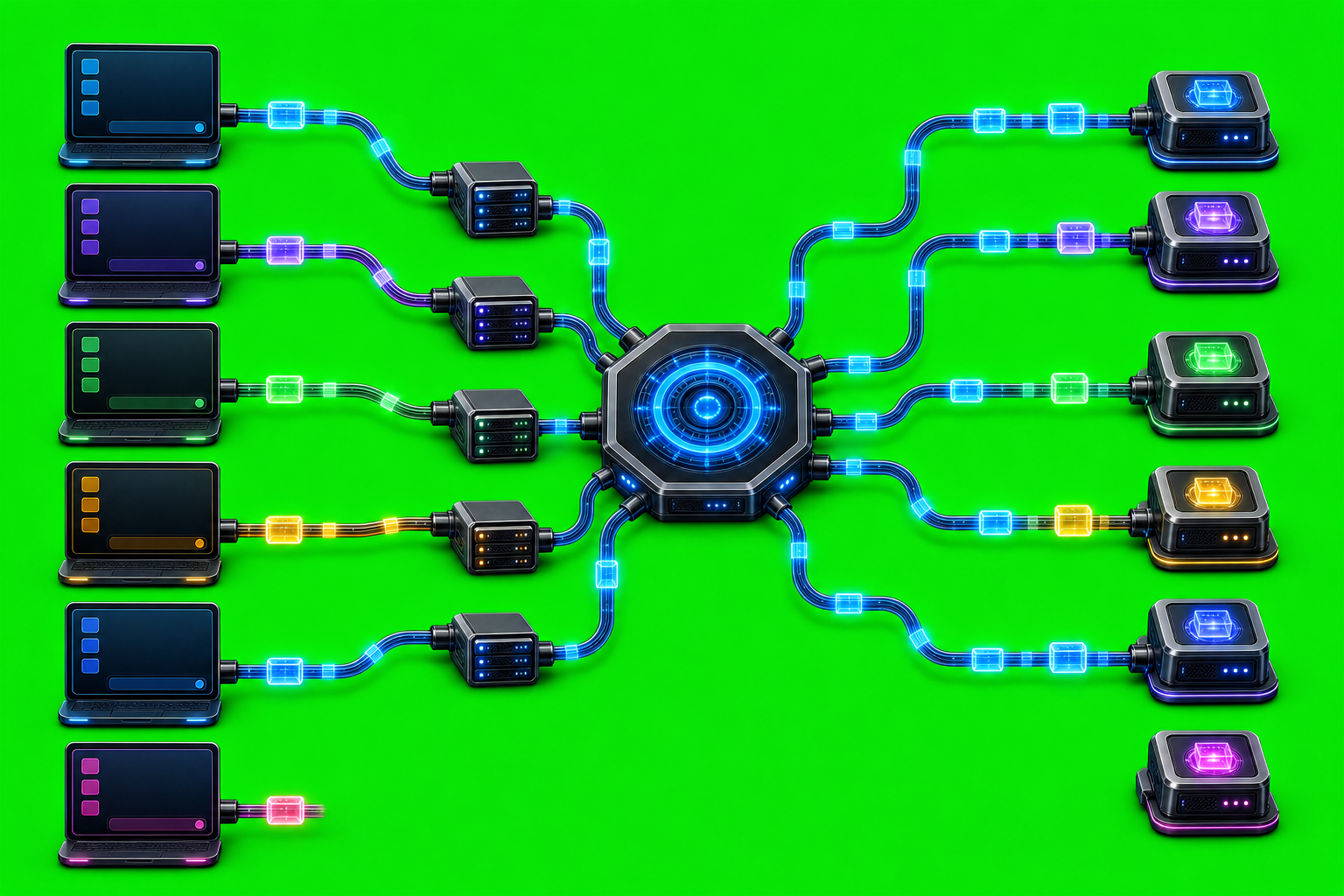
AxiOwl vs API-Only Agent Orchestration
API-only agent orchestration is a good fit when every participant is a programmable service with a stable endpoint, token, request format, response format, and lifecycle controlled by your application. That is not the world AxiOwl is built for. AxiOwl is designed for the messier operating reality where useful AI work is already happening inside existing provider sessions: Codex, VS Code chat, Cursor, Antigravity, and selected CLI provider surfaces.
AxiOwl's job is not to replace those providers with one abstract API. It is a local Windows coordinator that sends messages between supported provider sessions, exposes a CLI and MCP server, keeps a durable local registry, runs discovery, and dispatches delivery through provider-specific edges. The difference matters because desktop and CLI agent sessions are not interchangeable HTTP workers. They have local state, provider-owned session IDs, editor integrations, MCP metadata, active chat windows, and failure modes that an API-only design often cannot see.
The API-Only Model
In an API-only orchestration system, the orchestrator usually owns the whole loop. It creates jobs, sends prompts to model or agent APIs, receives structured results, retries failures, and stores state in its own database. That model can be clean and scalable, but it assumes the agent surface is available as an API-first dependency.
AxiOwl starts from a different premise: the session already exists somewhere. The target might be a Codex thread, a VS Code native chat, a Copilot-backed VS Code session, a Cursor agent window, an Antigravity session, or a CLI provider session. The useful question is not just "which API endpoint should receive this prompt?" It is "which real provider session is this named agent, can it currently receive a message, and can it reply with enough identity metadata for the route back to work?"
That is why the AxiOwl source emphasizes a durable registry instead of a simple endpoint list. Registry rows include human-readable names, aliases, provider values, provider session IDs, node IDs, sendability, discovery source, last-seen timestamps, verification timestamps, and last errors. This is operational state, not just configuration.
How AxiOwl Routes Messages
The current architecture routes both CLI and MCP requests through the same core pipeline:
CLI or MCP request
  -> axiowl.exe
  -> MessagePipeline
  -> sender and target validation
  -> registry lookup
  -> targeted discovery repair when needed
  -> final visible body builder
  -> provider_edges dispatch
  -> provider-specific delivery
  -> logs, receipts, and proof
From the operator side, the common CLI shape is direct:
axiowl send --to "Target chat name" --body "Message text"
From a provider session, AxiOwl exposes MCP tools such as axiowl_send_message, axiowl_create_agent, axiowl_list_agents, axiowl_discover, axiowl_status, and axiowl_whoami. The MCP implementation is not just a convenience wrapper around a shell command. Its tool description says axiowl_send_message uses the host MCP session ID as the stable sender identity key, and the server instructions tell providers to use typed tools instead of inventing raw axiowl send arguments.
That is a major practical difference from API-only orchestration. AxiOwl does not want a receiving chat to guess who it is. It wants provider-owned metadata or an equivalent provider-supported identity signal, so replies can route back to a real session instead of a stale display name.
Provider Edges Instead Of One Generic Adapter
An API-only orchestrator often wants one normalized transport. AxiOwl deliberately has provider-specific delivery modules.
The current provider dispatch table includes edges for codex, codex_cli, vscode_native, vscode_copilot_backed, antigravity, antigravity_cli, cursor, cursor_cli, claude_code_cli, copilot_cli, and opencode_cli. The support matrix is stricter than the existence of a code path: a provider is supported only when discovery, install/config, send, receive, MCP reply, and correct sender identity meet the test bar.
That prevents a common orchestration trap. Writing a config file or launching a process is not the same as proving that the target agent received the message and can answer through the routing layer. AxiOwl's docs distinguish an AxiOwl handoff receipt from stronger provider proof:
accepted_by_axiowlmeans AxiOwl accepted and validated the request and handed it to the delivery layer.- Provider acceptance means the provider edge reported that the target provider accepted the message.
- A response over MCP is the strongest proof because the target provider received the message, acted on it, and replied through AxiOwl with provider-owned sender identity.
API-only systems can have receipts too, but AxiOwl's receipt boundary is tuned for local provider surfaces where "I handed the payload to the adapter" is not the same thing as "the chat saw it and can reply."
Local State Is A Feature, Not A Weakness
AxiOwl reads and writes local operational state because its target environment is local. The trust-boundary docs list local provider session metadata, provider config files, provider chat or session indexes, AxiOwl registry files, runtime files, logs, license state, and installer provenance as expected read areas. It writes under %LOCALAPPDATA%\AxiOwl for the binary, manifest, logs, registry, and runtime state, plus selected provider MCP config, selected bridge extension files, and selected provider-owned AxiOwl config entries.
That makes AxiOwl different from an API-only control plane. It can discover and address provider sessions that live on the machine. It can install selected integration pieces such as MCP config, Codex plugin support, VS Code bridge extension files, Cursor bridge pieces, and provider-specific patches where selected. It can also leave clear local evidence: registry rows, delivery logs, create lifecycle logs, and installer logs.
The tradeoff is that AxiOwl must respect local boundaries. The installer behavior matrix says each provider feature should behave like a separate install unit. Unchecked provider features should not be installed, patched, closed, restarted, or removed as collateral damage. Patch-sensitive surfaces must fail loudly when unsafe. Remote features must not be used to hide local delivery failures.
That discipline is hard to get from a generic API-only abstraction because the abstraction tends to erase the provider-specific details operators actually need during a failure.
Where API-Only Still Wins
AxiOwl is not a replacement for every orchestration design. If all agents are API-native, stateless, centrally hosted, and designed to be called by a backend service, an API-only orchestrator is simpler. You can scale workers, centralize auth, apply one retry policy, and store the whole run in server-side state.
AxiOwl is more useful when the valuable work is distributed across provider sessions that already exist in local tools. It is for operator and developer workflows where the target is not just "a model," but a named session in a specific provider surface. That includes workflows where one agent needs to ask another active agent for help, where a local editor integration has the context, or where a provider's reply needs to prove both delivery and route-back identity.
Practical Operator Value
For operators, the AxiOwl approach gives several concrete advantages over an API-only mindset:
- Named session routing: operators can send to a registered chat name rather than a raw endpoint.
- Discovery-backed registry state: AxiOwl can find sessions, update last-seen data, and avoid treating stale rows as sendable.
- Provider-specific delivery: provider weirdness stays at provider edges instead of being hidden behind a fake universal adapter.
- MCP reply path: providers can reply through
axiowl_send_messagewith session identity metadata. - Clear receipt boundaries: AxiOwl separates local acceptance from provider acceptance and end-to-end reply proof.
- Local auditability: logs, registry files, runtime handoff files, and installer evidence live where the operator can inspect them.
The result is less abstract, but more honest. AxiOwl does not claim that every provider is the same. It gives each supported surface a route, an installer/config story, a discovery story, and a proof bar.
The Real Comparison
The real comparison is not "local tool versus cloud API." It is "provider-aware orchestration versus endpoint-only orchestration."
API-only orchestration is clean when the world is already API-shaped. AxiOwl is built for the parts of agent work that are not. It coordinates existing provider sessions through a local executable, CLI, MCP server, durable registry, targeted discovery, and provider-specific delivery modules. It treats sender identity, provider session IDs, sendability, receipts, and reply proof as first-class operational facts.
That makes AxiOwl a practical fit for multi-agent work happening across real desktop and CLI provider sessions. It does not hide the local system. It makes the local system routable, inspectable, and testable.