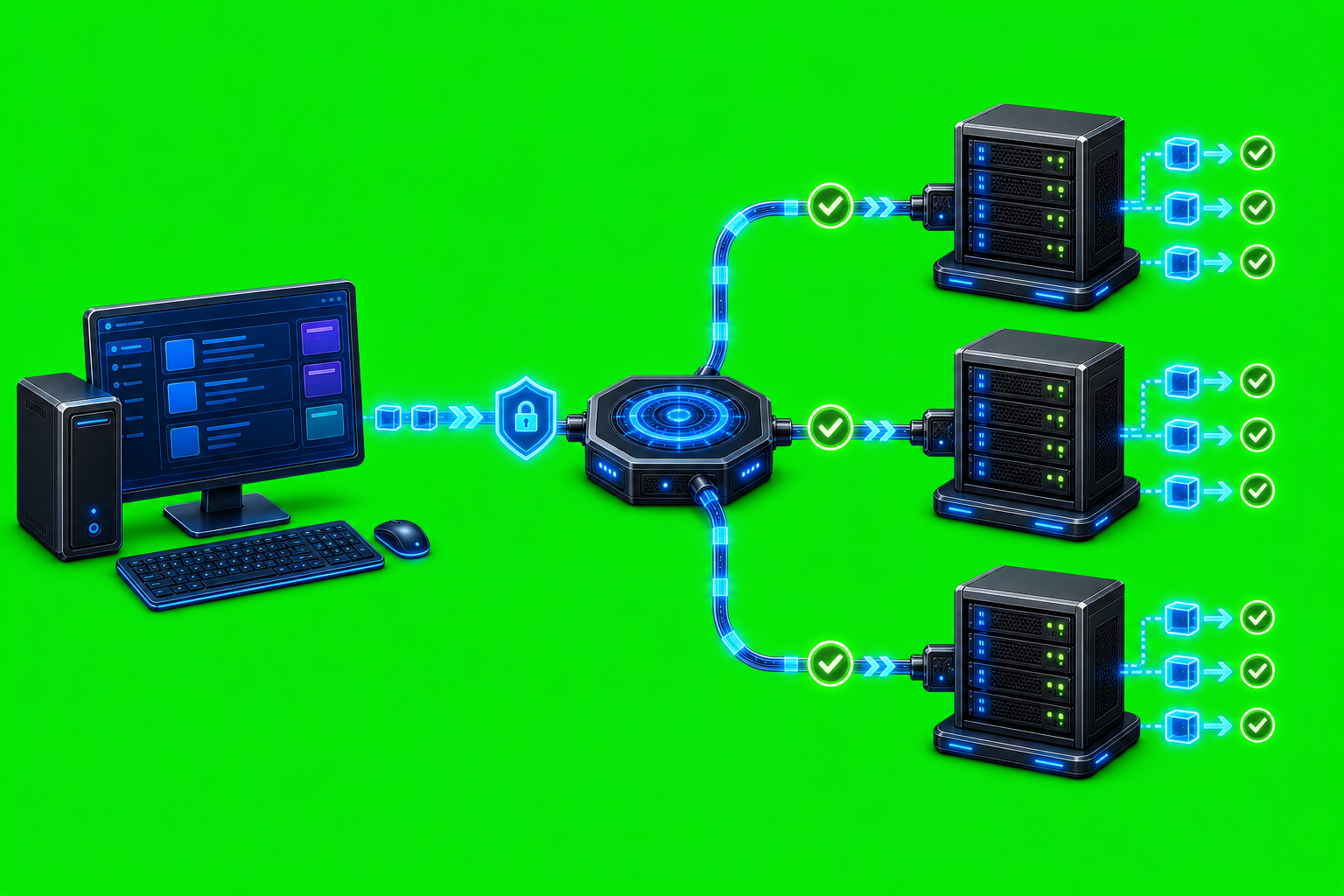
AxiOwl vs Manual SSH Workflows
Manual SSH is still one of the most useful tools an operator has. It is direct, inspectable, and universal enough to reach almost any Linux node that has a shell and a key. But manual SSH is also easy to turn into an untracked workflow: a remembered host, a copied command, a pasted message, a guessed target, and a mental note about whether anything actually happened.
AxiOwl takes a different approach. It does not pretend SSH is obsolete. In the current Windows desktop implementation, remote delivery is explicitly an outbound SSH workflow. The difference is that AxiOwl wraps that remote hop in a product contract: named sender, named target, registry lookup, final visible body construction, provider edge dispatch, evidence logging, and an honest receipt.
That turns remote agent messaging from "I pasted something into a shell somewhere" into "AxiOwl resolved this target, used this node, ran this relay method, and recorded this result."
What Manual SSH Gives You
A manual SSH workflow is simple when the task is small:
ssh -i C:\path\to\key user@host "some remote command"
For one-off system administration, that simplicity is a strength. You know exactly which command you typed. You can see stdout and stderr. You can adjust quickly when the remote machine is missing a package, using a different shell, or sitting in an unexpected directory.
The trouble starts when SSH becomes the message transport between AI sessions. At that point the operator has to remember more than the host:
- which remote node owns the target chat;
- which provider is behind that chat;
- which session id or chat name is current;
- how to format multiline content safely;
- whether the message body needs reply instructions;
- whether the target accepted the message or merely accepted a shell command;
- where evidence of the send is stored.
Those details are manageable once. They become fragile when multiple provider sessions, remote nodes, and agents are involved.
What AxiOwl Adds
AxiOwl is designed as a local message transport for agent chats. Its product contract is intentionally narrow: a named sender sends a text body to a named target, AxiOwl resolves both names, builds the final visible message, uses one provider edge to deliver it, records what happened, and returns a receipt that does not claim more than the evidence proves.
The common user-facing shape is:
axiowl send --to "Target chat name" --body "Message text"
For multiline content, the planned and documented shape uses stdin:
@'
Line one
Line two
"quotes are safe here"
'@ | axiowl send --to "Target chat name" --stdin
That command is not just a prettier SSH alias. In the current implementation and design docs, a send runs through a fixed pipeline:
CLI or MCP tool
-> message pipeline
-> sender resolution
-> target registry lookup
-> final visible body builder
-> provider edge dispatch
-> evidence log
-> receipt
The provider-specific part is isolated behind provider edges. The middle of AxiOwl does not need to know how every provider works internally. It calls an adapter with a final visible body and expects a structured result: provider, state, accepted flag, degraded flag, error text, evidence, method used, and timing information.
The Registry Replaces Host Memory
In a manual workflow, the operator often carries routing state in notes or memory: "front is this host, that chat is on that node, this key works there." AxiOwl makes that routing state explicit.
The registry model maps agent names and aliases to provider sessions. The remote node setup documented in the Windows desktop README uses commands like:
axiowl registry add-node --id "front" --host "<host>" --user "<ssh-user>" --key "<ssh-key-path>"
axiowl registry add-agent --name "Remote Test" --provider remote --node "front" --session "<remote agent name>"
axiowl send --to "Remote Test" --body "hello"
That matters because the target name becomes stable for the operator. The remote host, SSH user, key path, node id, and remote target name live in AxiOwl state instead of being reconstructed every time someone needs to send a message.
The discovery and registry docs also draw a useful line between facts AxiOwl has discovered and targets that are actually enrolled for sending:
discovered != enrolled
enrolled != live
live != replied
That distinction is easy to lose in manual SSH work. Seeing a file, process, or old chat record on a remote node is not the same thing as having a sendable target. AxiOwl's registry rules are built to keep that difference visible.
Remote Delivery Still Uses SSH, But With a Protocol
The Windows desktop README states the current runtime split plainly: the Windows build is the local coordinator, registry owner, and outbound SSH remote provider; the Linux build is a remote Codex endpoint, relay-session receiver, and Codex CLI delivery endpoint only.
The implementation in provider_remote.cpp shows the practical boundary. For a remote target, AxiOwl looks up the node in nodes.tsv, builds an SSH destination from the node's user and host, includes the configured key when present, and runs:
axiowl relay-session --stdio
on the remote machine. It does not just paste a provider command through SSH. It writes JSONL relay frames that include a hello frame and a deliver frame. The deliver frame carries the request id, target, final visible body, strict flag, sender metadata, and, when available, direct target provider details.
On the Linux side, remote_relay.cpp reads those JSON lines from stdin. It validates that a deliver frame has a target and body, then either dispatches directly to the requested provider target or runs the normal message pipeline on the remote node. It emits a structured deliver_result frame with state, provider, message id, error, and detail.
That is the core operational difference. Manual SSH gives you a remote shell command. AxiOwl uses SSH as the tunnel for a relay protocol.
Receipts Are Not Replies
One of AxiOwl's more important design choices is restraint. The docs repeatedly separate local acceptance, provider acceptance, and end-to-end reply proof.
The product contract defines receipt states such as:
accepted_by_axiowl
accepted_by_provider
degraded
failed
unknown
The user docs also state that accepted_by_axiowl means AxiOwl accepted the message and handed it to the delivery layer. It does not prove that the target provider displayed or processed the message. A correct provider reply through AxiOwl MCP proves more, because it shows that the provider received the message, had AxiOwl MCP available, sent a reply through AxiOwl, and was identifiable as the sender session.
That distinction is harder to preserve in manual SSH. A shell exit code of zero might mean the remote command ran. It might not mean the intended chat displayed the message, took a turn, or had a return path. AxiOwl's receipt model is built to keep those boundaries explicit.
Why This Helps Operators
For an operator, the value is not that AxiOwl hides every detail. The value is that AxiOwl puts the right details in durable places.
Manual SSH asks the operator to manage quoting, targeting, message shape, evidence, and identity at the same time. AxiOwl assigns those responsibilities to separate parts of the system:
- the CLI reads arguments and stdin;
- the registry owns targets and nodes;
- sender resolution identifies who is sending;
- the final visible body builder constructs the message once;
- the provider edge performs one selected delivery method;
- the evidence log records what happened;
- the receipt reports the strongest result AxiOwl can actually prove.
The Codex integration skill reinforces the same boundary for provider-side use. It says to prefer the bundled AxiOwl MCP tool over shell commands because the tool receives Codex thread metadata. It also warns that CLI acceptance is different from a recipient reply. That is exactly the kind of identity and proof boundary that manual SSH cannot provide on its own.
Where Manual SSH Still Belongs
Manual SSH remains useful for setup, repair, diagnostics, and direct server administration. AxiOwl's own remote provider uses SSH because SSH is the practical way to reach a Linux node from the Windows coordinator.
But routine agent-to-agent messaging has different requirements than server administration. It needs target names, sender identity, body construction, provider-specific delivery, evidence, and receipts. Once those become part of the workflow, raw SSH is too low-level to be the operator interface.
The best mental model is not "AxiOwl instead of SSH." It is "AxiOwl above SSH." SSH remains the transport boundary for remote nodes. AxiOwl supplies the registry, protocol, provider dispatch, and proof model that make remote agent messaging operationally safe enough to repeat.
The Practical Difference
With manual SSH, the operator asks: "Which host do I connect to, and what command do I paste?"
With AxiOwl, the operator asks: "Which agent do I want to send to?"
That change is small at the command line and large in practice. AxiOwl's current implementation still respects the real constraints of remote nodes: the Windows build coordinates, the remote Linux side receives relay-session --stdio, and Linux remote delivery is intentionally narrow. But within those constraints, AxiOwl replaces ad hoc remote message passing with named targets, structured relay frames, provider edges, evidence logs, and receipts that say what actually happened.
For teams running multiple AI provider sessions across local and remote environments, that is the difference between a clever SSH habit and an operator-grade workflow.