AxiOwl vs Subagents
Subagents and AxiOwl can both help a person get work done with more than one AI assistant involved. They are not the same shape of system. A subagent pattern usually means a parent agent delegates a bounded task to a worker agent, then receives the result back inside the parent workflow. AxiOwl is different: it is a local coordinator for sending messages between named provider sessions, with a durable registry, provider-owned session identifiers, MCP reply metadata, provider-specific delivery edges, and evidence logs that separate a local handoff from real delivery proof.
That distinction matters because "multi-agent" is an overloaded phrase. In one system, the important object is the parent task and the temporary workers created underneath it. In AxiOwl, the important object is the provider session: a Codex thread, Cursor agent session, VS Code chat session, Antigravity conversation, or another supported surface that AxiOwl can discover, address, and verify.
What the subagent pattern is good at
In this article, "subagent" means the broad delegation pattern, not a claim about one specific vendor feature. A parent agent can split a job into smaller pieces, assign those pieces to worker agents, collect the results, and decide what belongs in the final answer or implementation. That pattern is useful for parallel research, code review, fixture collection, test planning, and other bounded work where one owner still keeps responsibility for the final integration.
The AxiOwl repo itself contains examples of that pattern as a development workflow. One Linux provider plan used six parallel subagents for provider learning, then a sequential build phase. A VS Code patcher implementation plan recommended subagents for fixture inventory, history extraction, installer-status review, process-lifecycle review, test-harness review, and final diff review. In that plan, the main agent still owned the implementation, reconciliation, and final integration. The plan even says to treat subagent output as audit evidence, not automatic approval.
That is a good use of subagents. It is also not the AxiOwl product model.
AxiOwl starts from real provider sessions
AxiOwl's architecture docs describe a local Windows coordinator for sending messages between AI provider sessions. The core path is:
user / provider MCP call / CLI
  -> axiowl.exe
  -> MCP or CLI command handler
  -> MessagePipeline
  -> registry target and sender resolution
  -> targeted discovery repair when needed
  -> provider_edges dispatch
  -> provider-specific delivery
  -> delivery logs and provider proof
The common user-facing send command is direct:
axiowl send --to "Target chat name" --body "Message text"
For longer messages, the CLI supports stdin:
@'
Full message with code, JSON, quotes, or lists.
'@ | axiowl send --to "Target chat name" --stdin
That is not a parent agent spawning a helper. It is a directed message from one resolved sender to one resolved target. The target is not just a role name like "researcher" or "reviewer." It is a registry row that can include a display name, aliases, provider name, provider session ID, node ID, sendability, source, last-seen time, verification time, and last error.
The registry tests reinforce this model. Exact provider session matches win over ordinary name lookup. Duplicate names can exist across different sessions, and lookup prefers the newest row unless an exact session ID is used. Weak evidence alone does not create a sendable Codex row. A targeted Codex row with stronger IPC owner proof can be enrolled as sendable. That is session routing, not role delegation.
Sender identity is stricter than a parent-child relationship
In a subagent workflow, the parent usually knows which worker it launched. The parent can label the worker, summarize the assignment, and decide how much context the worker receives. The worker's output returns to the parent process or conversation because the parent owns the delegation.
AxiOwl cannot rely on that relationship. It has to route replies back to a real provider session. That is why sender identity is a hard boundary in the AxiOwl source.
The developer docs state that sender identity should resolve through provider-owned MCP metadata first, then an explicit provider session ID, then an explicit sender address or alias, then targeted discovery repair. The MCP server exposes axiowl_send_message, and its tool description says success is an MCP-to-AxiOwl handoff receipt only, not proof of provider delivery or reply. The MCP initialization instructions tell hosts to use typed AxiOwl tools, not raw argv, and not to make the chat invent its own session ID.
That is a major difference from subagent delegation. AxiOwl is not satisfied with "the sender is whatever worker was assigned this task." For reply routing, it needs a stable identity key that can be tied to a registered provider session.
Context boundaries are different
Subagents are usually part of one orchestration tree. A parent can pass each worker a selected prompt, files, instructions, or partial context, then synthesize the returned results. The useful boundary is task scope: this worker studies one area, that worker reviews another, and the parent keeps the final decision.
AxiOwl keeps a provider-session boundary instead. It sends a final visible body to the target provider edge. The target session sees the message body that AxiOwl builds for that delivery. It does not automatically join a shared parent transcript, inherit another provider's full conversation, or become a child of the sender.
The final visible body builder shows this clearly. When sender identity is resolved, AxiOwl builds a visible message headed with the sender name and appends an exact MCP reply instruction:
mcp__axiowl.axiowl_send_message({
  "to": "<sender>",
  "body": "<full reply>"
})
Tests assert that old shell fallback wording does not return in that helper. The preferred reply path is the installed AxiOwl MCP tool because it can carry the metadata needed to identify the replying session. If the sender is unresolved, AxiOwl warns that no send-back command is attached.
That is not a subagent returning a result to its parent. It is one provider session being asked to reply through a route that AxiOwl can identify.
Routing is provider-edge based
A subagent system can often hide worker mechanics behind the parent orchestrator. The parent asks a worker to do something, then waits for output. The mechanics might be in-process, remote, hosted, framework-specific, or tool-specific.
AxiOwl makes the delivery edge explicit. The provider dispatch table routes providers such as codex, codex_cli, vscode_native, vscode_copilot_backed, antigravity, antigravity_cli, cursor, claude_code_cli, copilot_cli, and opencode_cli to provider-specific delivery functions. Unknown providers fail as unknown. Remote is explicitly treated as out of scope for the local-provider remediation build in the current provider matrix, and the remote docs warn that remote fallback must not hide local provider failures.
That explicitness is important. AxiOwl does not pretend every provider session speaks one common subagent protocol. It keeps the middle of the system small: resolve sender, resolve target, build final visible body, choose one provider edge, hand off delivery, and log evidence. Provider-specific details stay at the provider edge.
Support means proof, not just configuration
One of the clearest differences is the support bar. A subagent workflow may be useful as soon as the parent can create or call the worker and receive a result. AxiOwl's provider support bar is stricter because it is not enough to write a config file or start a process.
The provider support matrix says a provider surface is supported only when the full path works:
- Discovery.
- Install and configuration.
- Send.
- Provider receive.
- Provider MCP reply.
- Correct sender identity.
The matrix marks supported surfaces separately from target and unsupported surfaces. It also states that CLI-provider metadata must come from real MCP metadata or a provider patch, not environment-only identity. That rule exists because a reply has to route back to a provider-owned session, not to a guessed display name.
This is also why the Hermes provider plan says Hermes internal delegation or subagents would not automatically become AxiOwl targets. A Hermes child agent would become addressable only if Hermes exposed stable identities and a deliverable session surface that AxiOwl could discover and prove. That sentence generalizes well: a subagent is not an AxiOwl target merely because it exists inside another agent product. It becomes an AxiOwl target only when there is an addressable provider session surface with evidence.
Receipts are deliberately modest
Subagent systems often make the parent transcript the natural proof artifact. The parent can show which worker was assigned, what it returned, and how the parent used it.
AxiOwl has a different evidence model. The architecture docs separate three levels:
accepted_by_axiowl: AxiOwl accepted and validated the request and handed it to the delivery layer.accepted_by_provider: the provider edge reported that the target provider accepted the message.- response over MCP: the strongest end-to-end proof, because it shows the target provider received the message, acted on it, and replied through AxiOwl with provider-owned sender identity.
The tests enforce this boundary. core_tests.cpp requires the sender receipt path to return accepted_by_axiowl, not accepted_by_provider. It checks that the receipt boundary is logged after target resolution and before delivery worker or provider work. It also checks that the sender receipt path does not wait for provider result.
That makes AxiOwl conservative by design. A local handoff is not advertised as full delivery. A provider reply with correct metadata proves more.
Where subagents fit
Subagents are a strong fit when the main job is decomposition under one owner. Use them when a parent agent should split a problem, run parallel investigations, collect reviews, compare findings, and produce one integrated output. That pattern works especially well for bounded evidence-gathering, test planning, code review, and exploratory research.
AxiOwl is a stronger fit when the main job is coordination between real provider sessions. Use it when the important questions are:
- Which provider session is the sender?
- Which provider session is the target?
- Does the target have a provider-owned session ID?
- Which provider edge owns delivery?
- Did AxiOwl only accept the message, or did the provider accept it?
- Did the target reply through MCP with identity AxiOwl can route?
Those questions are more operational than orchestration-theory questions. They matter when a user already has work spread across Codex, Cursor, VS Code, Antigravity, CLI sessions, or other provider surfaces and wants directed message routing without pretending those sessions are temporary children of one parent.
The clean comparison
The shortest version is this:
| Dimension | Subagent pattern | AxiOwl |
|---|---|---|
| Main purpose | Delegate bounded work under a parent agent | Route messages between existing provider sessions |
| Identity | Often assigned by the parent workflow | Resolved from provider metadata, provider session IDs, aliases, and registry rows |
| Context | Usually task-scoped context from the parent | Final visible message delivered to a target provider session |
| Routing | Parent-to-worker and worker-to-parent | Sender session to target session through one provider edge |
| Evidence | Worker output and parent synthesis | Handoff receipt, provider acceptance evidence, and MCP reply proof |
| Best use | Parallel research, review, decomposition, synthesis | Local provider-session messaging with explicit sender and delivery boundaries |
Both models are useful. They solve different problems.
Closing
AxiOwl should not be described as a generic subagent manager. The C++ repo supports a narrower and stronger claim: AxiOwl coordinates messages between named provider sessions on a local machine, resolves sender and target identity through a durable registry, dispatches through provider-specific edges, and logs what has actually been proven.
Subagents help a parent agent divide work. AxiOwl helps real provider sessions address each other. When the goal is decomposition, subagents are the natural tool. When the goal is "send this to that actual session and know what level of proof we have," AxiOwl is the better mental model.
Sources read
AxiOwl product sources:
C:\Users\kjhgf\OneDrive\Documents\postfourth\axiowl-cplus\README.mdC:\Users\kjhgf\OneDrive\Documents\postfourth\axiowl-cplus\docs\user\README.mdC:\Users\kjhgf\OneDrive\Documents\postfourth\axiowl-cplus\docs\developer\README.mdC:\Users\kjhgf\OneDrive\Documents\postfourth\axiowl-cplus\docs\security\trust-boundaries.mdC:\Users\kjhgf\OneDrive\Documents\postfourth\axiowl-cplus\docs\reference\architecture-overview.mdC:\Users\kjhgf\OneDrive\Documents\postfourth\axiowl-cplus\docs\reference\provider-support-matrix.mdC:\Users\kjhgf\OneDrive\Documents\postfourth\axiowl-cplus\docs\reference\installer-behavior-matrix.mdC:\Users\kjhgf\OneDrive\Documents\postfourth\axiowl-cplus\docs\providers\README.mdC:\Users\kjhgf\OneDrive\Documents\postfourth\axiowl-cplus\docs\providers\codex-agents.mdC:\Users\kjhgf\OneDrive\Documents\postfourth\axiowl-cplus\docs\providers\remote.mdC:\Users\kjhgf\OneDrive\Documents\postfourth\axiowl-cplus\docs\plans\02-message-pipeline.mdC:\Users\kjhgf\OneDrive\Documents\postfourth\axiowl-cplus\docs\linux-x86_64\plans\provider-cli-learning-orchestration-2026-07-04.mdC:\Users\kjhgf\OneDrive\Documents\postfourth\axiowl-cplus\docs\plans\VSCODE-PATCHER-CANONICAL-NORMALIZER-IMPLEMENTATION-PLAN-2026-07-05.mdC:\Users\kjhgf\OneDrive\Documents\postfourth\axiowl-cplus\docs\plans\HERMES-PROVIDER-SUPPORT-IMPLEMENTATION-PLAN-2026-07-07.mdC:\Users\kjhgf\OneDrive\Documents\postfourth\axiowl-cplus\apps\windows-desktop\src\cli.cppC:\Users\kjhgf\OneDrive\Documents\postfourth\axiowl-cplus\apps\windows-desktop\src\message_pipeline.cppC:\Users\kjhgf\OneDrive\Documents\postfourth\axiowl-cplus\apps\windows-desktop\src\mcp_server.cppC:\Users\kjhgf\OneDrive\Documents\postfourth\axiowl-cplus\apps\windows-desktop\src\models.hppC:\Users\kjhgf\OneDrive\Documents\postfourth\axiowl-cplus\apps\windows-desktop\src\registry.cppC:\Users\kjhgf\OneDrive\Documents\postfourth\axiowl-cplus\apps\windows-desktop\src\provider_edges.cppC:\Users\kjhgf\OneDrive\Documents\postfourth\axiowl-cplus\apps\windows-desktop\src\provider_remote.cppC:\Users\kjhgf\OneDrive\Documents\postfourth\axiowl-cplus\apps\windows-desktop\src\final_visible_body_builder.cppC:\Users\kjhgf\OneDrive\Documents\postfourth\axiowl-cplus\apps\windows-desktop\src\evidence_log.cppC:\Users\kjhgf\OneDrive\Documents\postfourth\axiowl-cplus\apps\windows-desktop\tests\core_tests.cppC:\Users\kjhgf\OneDrive\Documents\postfourth\axiowl-cplus\apps\windows-desktop\tests\installer_provider_contract_tests.cppC:\Users\kjhgf\OneDrive\Documents\postfourth\axiowl-cplus\apps\windows-desktop\tests\mcp_conformance.ps1
External sources: none.
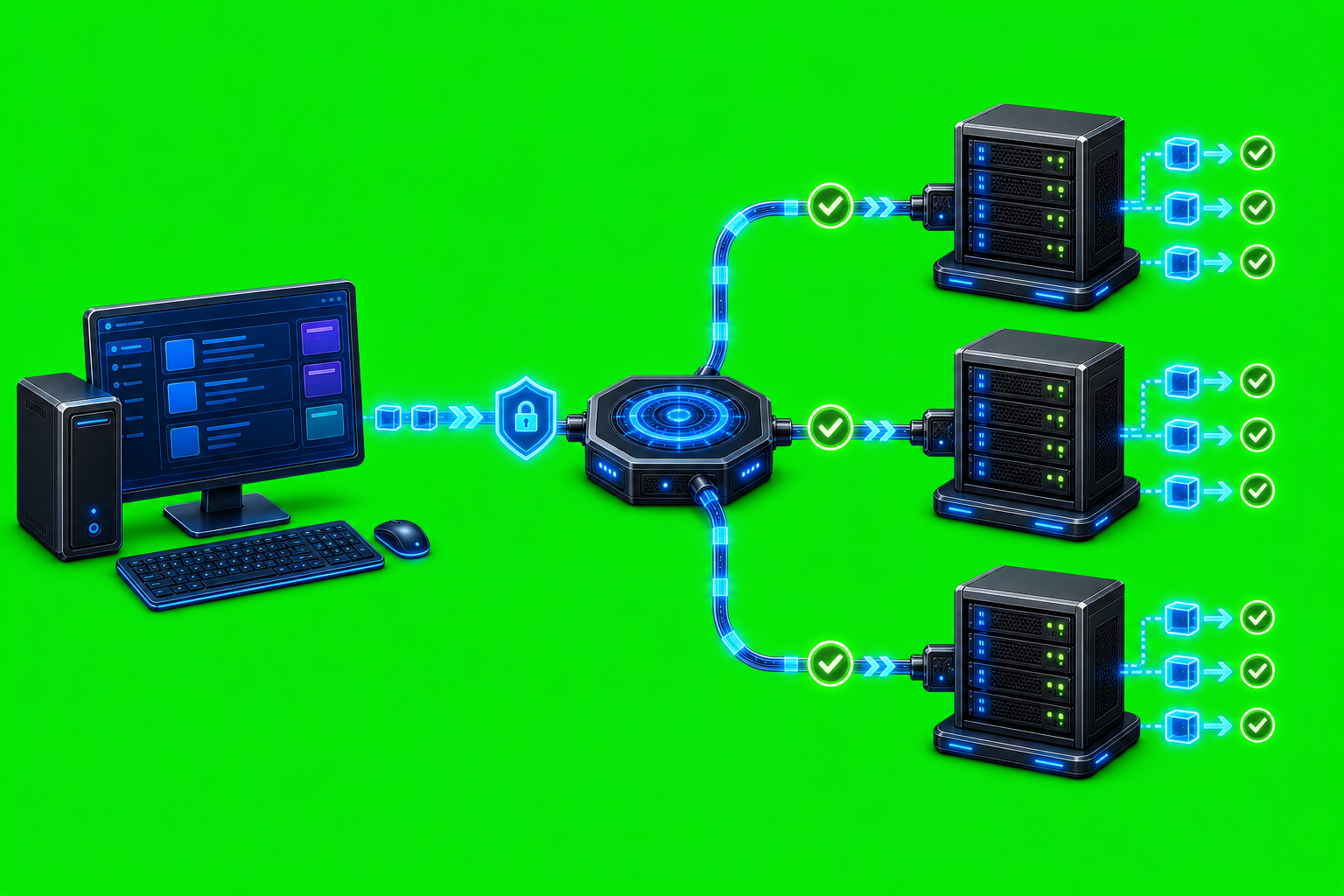
Image prompt:
Create a polished graphic image related to: AxiOwl provider-session routing compared with subagent task delegation.
Subject: a split technical comparison scene with a parent console dispatching three blank task cards into nested worker panes on one side, and a local workstation router connecting separate blank provider-session terminals with distinct cables on the other side; use only unlabeled geometric panels, cables, ports, check indicators, and signal paths; no readable text.
Style: halfway between a clean symbolic icon and a realistic product/technical illustration; professional SaaS/technical marketing style; crisp edges; high detail; no text; no logos.
Background: solid #00ff00 chroma key green screen background covering the full canvas edge to edge.
Restrictions: no owl, no axolotl, no birds, no animals, no mascot, no text, no watermark.