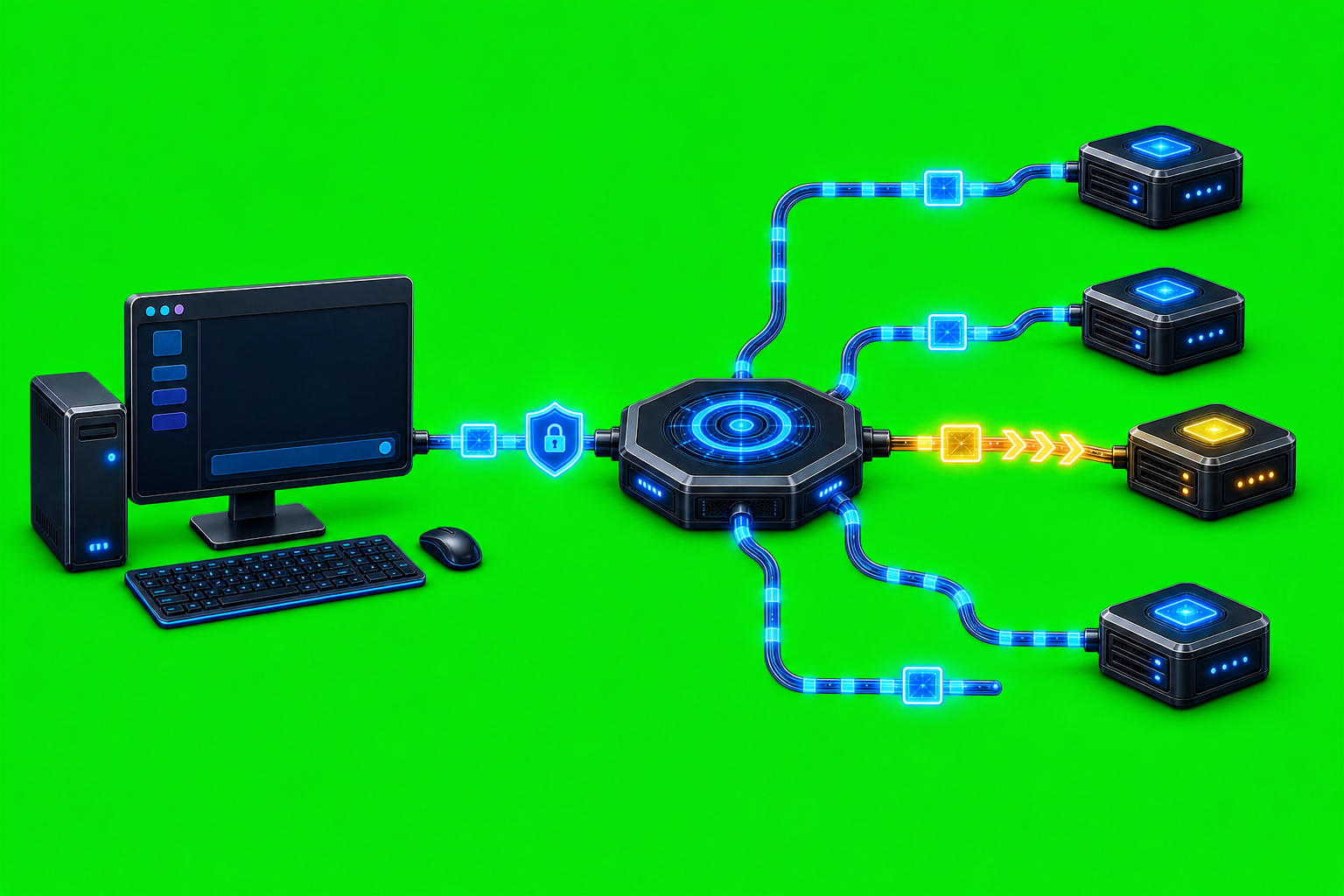
AxiOwl vs Traditional Automation Tools
Traditional automation tools are usually built around executing steps. A script runs commands. A workflow engine moves data through tasks. A macro clicks or types through a user interface. Those tools can be valuable, but they are not usually designed around the problem AxiOwl is solving: letting named AI-agent chats send messages to other named AI-agent chats across provider surfaces, local machines, and remote nodes with a receipt that says only what can be proven.
AxiOwl is not a general automation platform. The product contract in the AxiOwl repository defines it more narrowly as a local message transport for agent chats. A named sender sends a text body to a named target. AxiOwl resolves both names, builds the final visible message, selects exactly one provider edge, records evidence, and returns an honest receipt.
That narrower job is the main difference. Traditional automation often asks, "What steps should run next?" AxiOwl asks, "Which real agent chat is the target, which provider owns it, what route can carry this message, and what evidence do we have that the handoff happened?"
Automation Runs Steps; AxiOwl Routes Messages
A normal automation script might call a CLI, write a file, hit an API, wait for output, then continue. AxiOwl's basic user command is different:
axiowl send --to "<agent>" --body "<message>"
For long or structured content, the intended shape is stdin:
@'
<full message>
'@ | axiowl send --to "<agent>" --stdin
The user does not choose the delivery adapter in the normal send path. The target name is resolved through AxiOwl's registry, and the registry row determines the provider, provider session ID, node ID, and sendability state.
That makes AxiOwl closer to a routing layer than a task runner. It is not trying to sequence arbitrary business logic. It is trying to move a visible message from one agent context to another without forcing the sender to know the target's provider internals.
The Registry Replaces Ad Hoc Target Guessing
Traditional automation often relies on hardcoded paths, environment variables, URLs, window titles, or command arguments. AxiOwl uses a registry as the routing source of truth.
The planned registry model is intentionally plain:
agent name -> provider -> provider session id -> node
The implementation and docs describe richer rows around that core: display names, aliases, provider values, provider-owned session IDs, node IDs, enabled and sendable flags, discovery source, timestamps, and last error. This matters because an AI-agent target is not just a name. "Build Agent" or "Cloud Local Agent" has to resolve to something concrete: maybe a Codex thread, a VS Code native session, a Copilot-backed VS Code session, an Antigravity conversation, or a remote Codex target.
AxiOwl also separates discovery from enrollment. The docs are explicit:
discovered != enrolled
enrolled != live
live != replied
That distinction is important operationally. A discovery pass may find a provider fact, but AxiOwl should not treat that fact as a sendable target until the provider is known, the session ID is known, the node is known, and the send path is supported or proven. This is more conservative than a macro or script that scans for something plausible at runtime and acts immediately.
Provider Edges Are Isolated
Traditional automation can become brittle when every system-specific behavior is folded into one large script. AxiOwl's design keeps provider-specific behavior behind provider edges.
The provider edge contract is small. An edge receives the message ID, target display name, provider session ID, node context, final visible body, timeout policy, and strictness setting. It returns a provider, state, accepted flag, degraded flag, error, evidence, method used, and timing fields.
The edge does not receive the original body as something to rewrite. It does not append helper text. It does not decide that a failed VS Code target should silently become a Codex target. Fallbacks are allowed only inside the same provider family, and degraded paths have to say what property was lost.
This is one of AxiOwl's strongest contrasts with conventional automation. In many automation scripts, a fallback is just another branch. In AxiOwl, fallback behavior is part of the receipt boundary. A degraded route must be visible because the operator needs to know whether the original target and delivery property were preserved.
The Message Body Is Built Once
AxiOwl does not let every provider adapter invent its own message wrapper. The send pipeline builds one final visible body after sender and target resolution.
The design shape is:
CLI
-> local service
-> sender resolution
-> target resolution
-> final visible body builder
-> provider edge
-> evidence log
-> receipt
For a resolved sender, the final visible body includes the sender identity, the original message body, and instructions for sending AxiOwl content back only when needed. If the sender cannot be resolved, ordinary sends can include a visible warning, while strict sends should fail before provider dispatch.
That is different from traditional automation because the payload is not just an opaque string moving through a pipeline. It is a message that will be visible inside another agent chat. The receiving agent needs to know who sent it and how to reply through AxiOwl if a reply is needed.
Receipts Are Not Treated Like Replies
A major automation trap is confusing "the command ran" with "the work is done." AxiOwl's docs draw a hard line between acceptance, provider delivery, and replies.
The receipt states include:
accepted_by_axiowl
accepted_by_provider
degraded
failed
unknown
The command line must not print a stronger receipt than the evidence supports. AxiOwl accepting a request is not the same as the provider accepting it. Provider acceptance is not the same as a receiver replying. A reply is a future message initiated by the receiver through a new AxiOwl send pipeline.
The Windows README shows this boundary in the current implementation status too. The CLI skeleton, fixed send pipeline, create-session pipeline, TSV registry, final visible body builder, JSONL evidence log, provider edge interface, and live provider delivery for current local Windows edges are implemented. The always-running local service is not implemented yet, and the current CLI runs the local pipeline directly. That is a concrete implementation detail, not a marketing abstraction.
For operators, the honest receipt model is more useful than a vague success message. It lets them distinguish "AxiOwl accepted the request," "the provider accepted the send," "delivery failed loudly," and "the system cannot prove more than this."
Remote Delivery Is Transported, Not Publicly Exposed
Traditional automation often solves remote execution by exposing a service, running a remote agent, or copying scripts around. AxiOwl's remote provider plan is narrower: local AxiOwl sends to agents on another machine through that machine's own AxiOwl installation.
The current remote model uses outbound SSH from the local side:
ssh -i "<key path>" <ssh_user>@<host> "axiowl relay-session --stdio"
The remote command surface is:
axiowl relay-session --stdio
The protocol uses newline-delimited JSON frames over stdio, with frames such as hello, deliver, deliver_result, and error. The docs explicitly reject durable hidden replay files and stored failed-message queues. If a remote receiver needs to reply, it starts a normal AxiOwl send from the remote node. If no live upstream relay exists, the system should fail loudly instead of writing a hidden replay row.
The current Linux remote scope is also explicit: remote Linux AxiOwl supports Codex CLI delivery only. It does not support VS Code, Antigravity, desktop IPC, GUI, tray behavior, or remote relay chaining. That narrow support boundary is valuable because it prevents AxiOwl from implying a general remote automation capability that is not implemented.
AxiOwl Still Uses CLI And MCP Surfaces
AxiOwl is not rejecting ordinary automation interfaces. It exposes CLI commands and installs MCP-facing integrations so agents can call AxiOwl from inside supported host surfaces.
The Windows CLI help includes commands for:
send
create
rename
discover
list agents
registry add-agent
registry add-node
node verify
status
mcp-server
delivery-worker
relay-session --stdio
The installer line also installs axiowl.exe, a native MCP server mode, an internal delivery worker, a VS Code bridge extension, Codex plugin material, and MCP config entries for VS Code, Gemini, and Antigravity. After install, it runs lightweight local discovery for Codex, VS Code native, VS Code Copilot, and Antigravity.
So the difference is not "AxiOwl has a CLI and traditional tools do too." The difference is what that CLI is for. In AxiOwl, the CLI is a front door into a message transport contract: registry lookup, final body construction, provider edge dispatch, evidence logging, and a bounded receipt.
When AxiOwl Is The Right Fit
Traditional automation tools are still the right answer for many jobs: building software, transforming files, running scheduled tasks, calling APIs, deploying infrastructure, and orchestrating deterministic workflows.
AxiOwl is the better fit when the unit of work is an agent message, not a shell command. It is useful when teams need named AI-agent chats to hand work to each other, when targets live across different provider surfaces, when remote nodes matter, and when operators need evidence instead of a vague "sent" status.
The key practical values are:
- Agents can address other agents by name instead of provider session IDs.
- Provider-specific delivery details stay behind isolated edges.
- Discovery facts do not automatically become sendable routes.
- The visible message body is built once in a consistent shape.
- Receipts separate AxiOwl acceptance, provider acceptance, degraded delivery, failure, and unknown states.
- Remote delivery uses a bounded SSH relay model instead of assuming a public listener or hidden replay queue.
The Bottom Line
AxiOwl should not be judged as a replacement for scripts, workflow engines, or UI automation. It is solving a different coordination problem. Traditional automation runs steps. AxiOwl routes messages between named AI-agent chats and records what happened.
That focus is what makes the product useful. It does not need to pretend every provider is the same, every discovered chat is sendable, every handoff is a reply, or every remote path is supported. AxiOwl's value is the boring operational discipline around agent-to-agent messaging: resolve names, choose one provider edge, send the final visible body, log evidence, and return a receipt that stays inside the facts.