How AxiOwl Is Different From a Normal AI Chat App
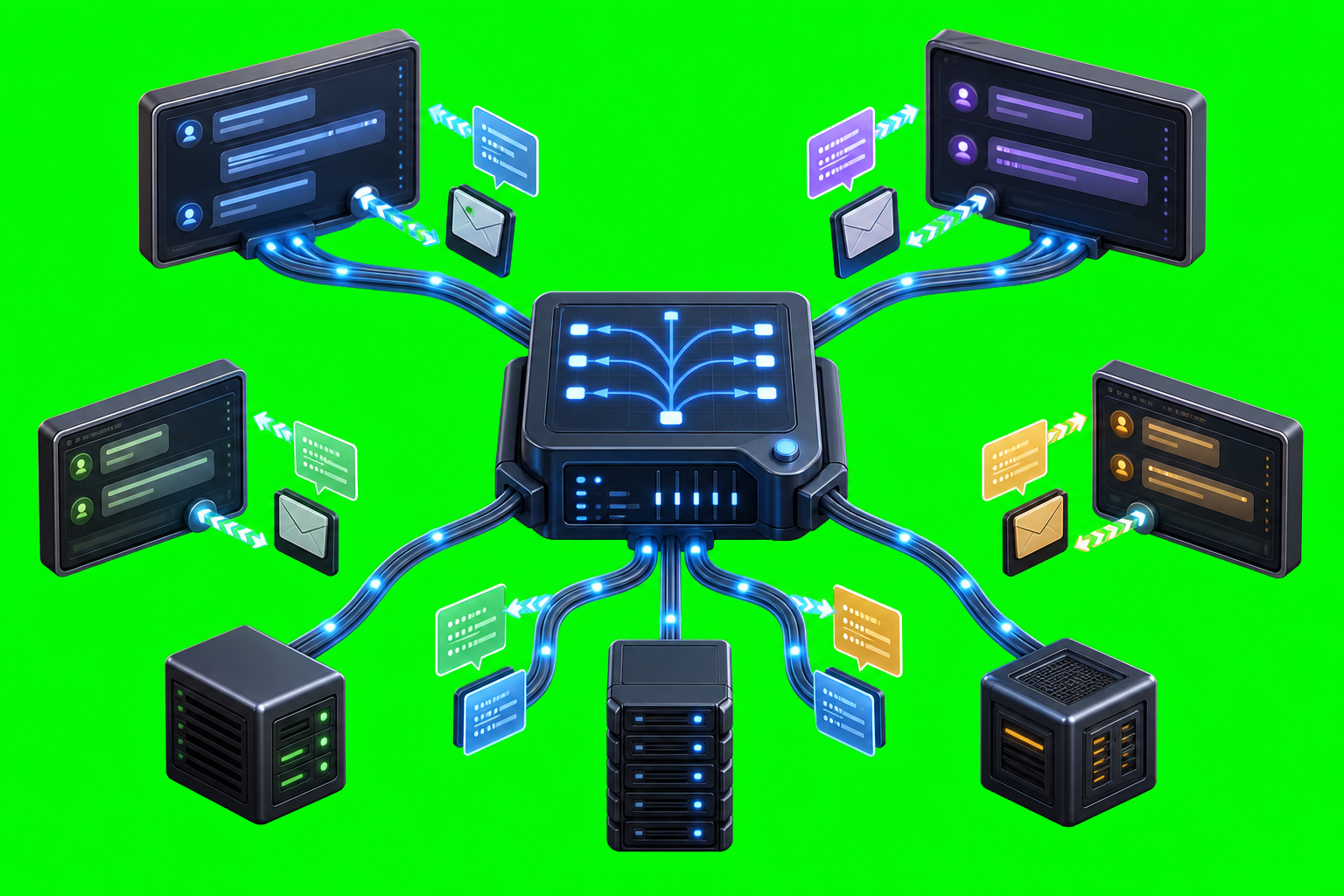
A normal AI chat app is usually built around one conversation: a person types into a chat window, one assistant answers in that same window, and the app treats that back-and-forth as the product. AxiOwl is built around a different job. It is a local message transport for agent chats: a named sender sends a text body to a named target, AxiOwl resolves both names, chooses a provider route, hands the message to one provider edge, records evidence, and returns a receipt that says only what it can prove.
That difference matters because agent work often does not happen in one chat. A developer may have Codex, Cursor, Antigravity, VS Code-backed sessions, CLI sessions, and remote nodes involved in the same operating workflow. AxiOwl is not trying to replace those tools with one more chat box. Its job is to let those existing agent surfaces address each other by name through a small, inspectable routing layer.
AxiOwl Is Transport, Not Another Assistant
The product contract in the AxiOwl repo is intentionally narrow. A sender sends a body to a target. AxiOwl resolves the sender and target. It builds the final visible message once. It selects exactly one provider edge. It records what happened. Then it returns a receipt.
That is not how a typical chat product presents itself. A normal chat app usually focuses on prompt composition, model response quality, chat history, and a single assistant experience. AxiOwl focuses on delivery between already-existing agent chats. The command shape reflects that:
axiowl send --to "<agent>" --body "<message>"
For longer messages, the intended shape is stdin:
@'
<full message>
'@ | axiowl send --to "<agent>" --stdin
The distinction is practical. AxiOwl does not ask the sender to know provider internals or paste a provider session ID into every message. The sender uses a target name. AxiOwl looks up that target in its registry and chooses the route.
Names Resolve Through a Registry
A normal chat app can assume the current conversation is the destination. AxiOwl cannot. Its core problem is target resolution: when someone says "send this to Cloud Local Agent," AxiOwl has to know which provider, which provider session ID, and which node that name refers to.
The registry is the source of truth. In the Windows implementation, agent rows are stored with fields for display name, aliases, provider, provider session ID, node ID, enabled state, sendable state, source, timestamps, and last error. Lookup is not just a string comparison against one title. The registry code checks display names, aliases, provider session IDs, and bare session identifiers, then prefers sendable rows and newer records when there are multiple candidates.
That makes AxiOwl closer to a routing table than a chat sidebar. The user-facing command can stay simple, while the implementation keeps the provider-specific facts where they belong.
Discovery Is Separate From Delivery
AxiOwl also separates discovery from enrollment. The design docs say it plainly: discovered does not mean enrolled, enrolled does not mean live, and live does not mean replied.
That is another major difference from a normal AI chat app. Chat apps usually show available conversations because those conversations already belong to that app. AxiOwl has to discover facts from other surfaces and decide whether those facts are safe to use for delivery.
The repo includes discovery paths for several provider families. The Linux CLI target has discovery for Codex CLI, Antigravity CLI, and OpenCode CLI, writing rows into a CLI provider registry. The Windows target exposes discovery commands for providers such as Codex, VS Code native, VS Code Copilot-backed, Copilot CLI, Antigravity, Cursor, Claude Code CLI, and OpenCode CLI. The support chart marks agent surfaces for several brands as supported and CLI surfaces for several providers as target work.
The important behavior is conservative enrollment. A target should become sendable only when AxiOwl knows enough: provider, session ID, node, and a supported or proven send path. Discovery-only facts are useful evidence, but they are not the same thing as a route.
AxiOwl Builds the Visible Message Once
When AxiOwl sends a message, the provider adapter does not get to invent its own wrapper text. The final visible body builder is a central part of the pipeline.
For a resolved sender, AxiOwl builds a body that starts with the sender identity, includes the original body, and appends an MCP reply instruction block that points back to the sender. The current implementation uses an mcp__axiowl.axiowl_send_message tool call shape for replies, with optional run and receipt metadata. If the sender cannot be resolved, AxiOwl uses a warning shape instead of attaching a send-back command.
That is different from a chat app because AxiOwl is not just showing text to a user. It is carrying message context across agent boundaries. The receiver needs to see who sent the message and, when appropriate, how to send AxiOwl content back. The sender identity is part of the transport contract, not casual prose.
Provider Edges Are Isolated
AxiOwl does not pretend every AI surface works the same way. The provider edge layer dispatches by provider value. The Windows implementation has provider routes for codex, codex_cli, vscode_native, vscode_copilot_backed, antigravity, antigravity_cli, cursor, cursor_cli, claude_code_cli, copilot_cli, opencode_cli, and remote. Unknown provider values fail loudly instead of being guessed.
This is one of AxiOwl's strongest boundaries. A normal chat app can hide its one backend behind a single send button. AxiOwl has to talk to multiple external agent surfaces, each with its own session model and delivery mechanics. The code keeps that complexity behind provider-specific edges so the send pipeline still has one shape:
CLI or MCP tool
-> sender resolution
-> target resolution
-> final visible body
-> provider edge
-> evidence log
-> receipt
Remote delivery has its own boundary too. The Windows remote provider uses SSH to run axiowl relay-session --stdio on a registered node. The Linux remote provider intentionally reports that broader remote chaining is not supported there; it is scoped as a Linux remote Codex endpoint. That kind of explicit limitation is part of the product behavior. AxiOwl should say what route it can use, not imply a route that is not implemented.
Receipts Are Honest About What Happened
The current CLI output is deliberately careful. If the request is accepted by AxiOwl but provider delivery is handed to the background worker, the receipt says:
AxiOwl handoff receipt: MCP/CLI request accepted by AxiOwl.
Delivery state: accepted_by_axiowl
Receipt boundary: provider delivery, provider wake-up, and provider reply are not implied.
That is very different from a normal chat app's "sent" feeling. In AxiOwl, a receipt is not a promise that the receiver replied, and it is not allowed to treat provider stdout as a response from the target agent. The docs define the boundary: a reply is a separate future message initiated by the receiver, not part of the original send receipt.
The implementation follows that idea by writing structured evidence. The evidence log appends JSON lines with event type, timestamp, message ID, provider, target, sender resolution, method used, acceptance state, errors, and body-size metadata. The delivery worker writes its own events and delivery stages. Status output also points operators at the registry, node registry, evidence log, delivery log, create lifecycle log, activation file, and local endpoint.
For operators, this is valuable because failures become inspectable. A target can be missing from the registry. A target can be known but not sendable. A provider can be unknown. A remote node can be missing host or SSH user data. A delivery worker handoff can fail. These are different states, and AxiOwl tries to keep them separate.
MCP Makes AxiOwl Available Inside Agent Hosts
AxiOwl is not only a command-line tool. The repo includes an MCP server that exposes tools such as axiowl_whoami, axiowl_list_agents, axiowl_send_message, axiowl_create_agent, axiowl_discover, axiowl_status, node tools, registry tools, and relay delivery.
The send tool is intentionally typed. Its description says the host MCP session ID is used as the stable sender identity key and that success is an MCP-to-AxiOwl handoff receipt only; provider delivery and reply are not implied. The server instructions tell hosts to use axiowl_send_message for sending and axiowl_create_agent for creating chats, and not to construct raw send arguments or invent a session ID manually.
That is another practical difference from a normal chat app. AxiOwl is designed for agents to use from inside their own host environment. The host provides metadata. AxiOwl resolves that metadata to a registered visible sender name, registers sender identity when possible, and then sends through the same pipeline as the CLI.
Why This Matters In Real Agent Work
The value of AxiOwl is not that it produces better model text than the provider tools it connects. The value is coordination.
When multiple agents are working in parallel, someone needs a reliable way to say, "send this exact message to that named agent," without manually locating the right chat, copying text between windows, or confusing a delivery receipt with an answer. AxiOwl gives that workflow a narrow contract:
- target names resolve through a registry
- provider details stay behind provider edges
- final visible bodies are built in one place
- delivery attempts write evidence
- receipts do not claim more than they know
- replies are new messages, not hidden continuations of the original send
That makes AxiOwl more like local coordination infrastructure than a chat app. It sits beside Codex, Cursor, Antigravity, VS Code, CLI providers, and remote nodes. It does not need to own the whole conversation experience. It needs to move messages between agent chats in a way an operator can inspect, debug, and trust.
The Short Version
A normal AI chat app is where you talk to an assistant. AxiOwl is how agent chats address each other.
The current repo backs that up with a concrete architecture: CLI and MCP entry points, sender and target resolution, a TSV-backed registry, provider-specific delivery edges, a background delivery worker, structured evidence logs, and careful receipt boundaries. AxiOwl is different because it treats messaging as an operational transport problem, not a single-chat user interface problem.