Using AxiOwl to Delegate Repetitive Engineering Tasks
Repetitive engineering work is rarely difficult because each individual step is complex. It is difficult because the same careful instructions have to be carried from one context to another: ask one assistant to inspect a code path, ask another to run a focused check, ask a third to review a patch, then bring the result back without losing which session did what.
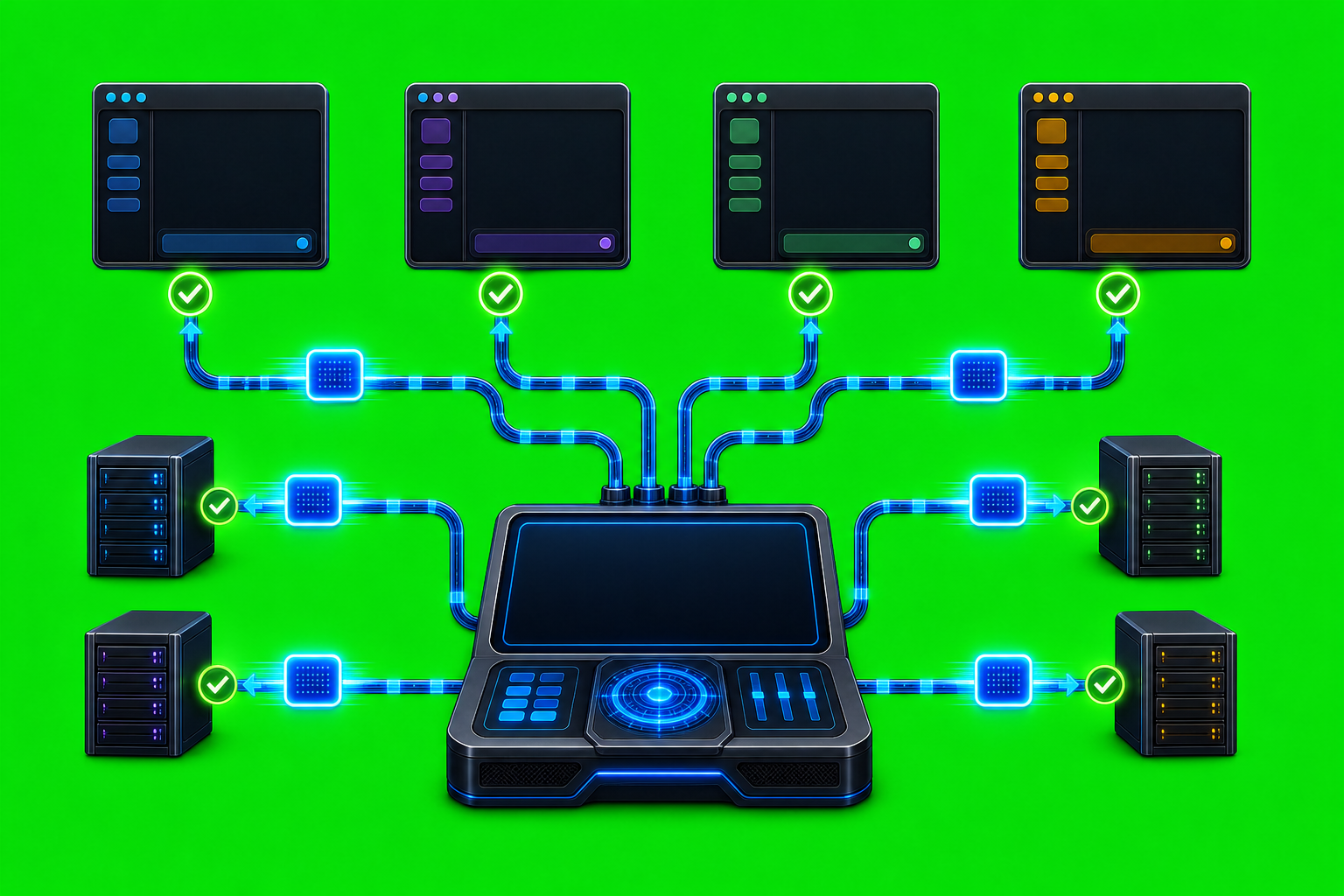
AxiOwl is built for that handoff layer. It is a local Windows coordinator that lets supported AI provider sessions send messages to each other through a CLI and an MCP server. Instead of treating every assistant window as an isolated conversation, AxiOwl keeps a local registry of reachable provider sessions and gives operators a way to route specific work requests to named targets.
That makes it useful for repetitive engineering tasks where the work packet is clear, the target session is known, and the operator wants a reply from the actual provider session that did the work.
Delegation Means Explicit Routing
AxiOwl is not a replacement for Codex, Cursor, VS Code, Antigravity, or another provider. The user docs describe it as a coordinator for local provider-to-provider messaging. Its job is to discover provider sessions, record them in a registry, send messages to selected sessions, expose MCP tools for replies, and log receipts and delivery evidence.
That distinction matters for engineering work. AxiOwl does not need to invent a new task system to help with repetition. The basic pattern is:
- Keep useful provider sessions discoverable and named.
- Send a concrete instruction to the right session.
- Require the receiving session to reply through AxiOwl MCP.
- Use the reply as stronger proof than a local send receipt.
The common CLI form is direct:
axiowl send --to "Target chat name" --body "Review the test failure and report the smallest likely fix."
For longer or more structured task packets, the CLI supports stdin:
Get-Content .\task-brief.md | axiowl send --to "Target chat name" --stdin
The same delegation idea exists through MCP. The AxiOwl MCP server exposes typed tools such as axiowl_send_message, axiowl_create_agent, axiowl_list_agents, axiowl_discover, axiowl_status, and axiowl_whoami. The implementation specifically instructs provider hosts to use axiowl_send_message for sending and axiowl_create_agent for creating chats, because those tools carry provider session identity instead of asking a chat to guess who it is.
The Registry Is What Makes Repetition Practical
Repetitive delegation breaks down if targets are remembered only as vague window titles. AxiOwl's registry model is designed to avoid that. A registry row represents a reachable provider session or agent and includes fields such as:
- display name
- aliases
- provider
- provider session id
- node id
- sendable state
- discovery source
- last seen time
- last verified time
- last error
That means an operator can build a repeatable workflow around named sessions. For example, one session might be the codebase reader, another might be the test runner, and another might be the review pass. AxiOwl can route to those targets by name while retaining the provider/session metadata needed for replies.
The source code also shows that sending is not just a blind string append. The MessagePipeline validates that the target and body exist, resolves sender identity, performs targeted discovery repair for stale or missing registry state, resolves the provider route, and then hands the request to provider-specific delivery.
For repetitive tasks, that gives the workflow a useful shape: the operator writes the task once, sends it to the intended session, and AxiOwl records what it accepted and how delivery progressed.
Good Repetitive Tasks Are Specific Work Packets
AxiOwl works best when the delegated task is concrete enough for a provider session to act on without negotiation. Examples include:
- "Inspect this file and list the highest-risk edge cases."
- "Run the focused test command already documented in the branch notes and report pass or fail."
- "Review this patch for behavior changes and missing validation."
- "Compare the current implementation against this checklist and return only unresolved items."
- "Create a new provider chat named for this investigation and start it with the attached brief."
The create command supports that last workflow:
axiowl create --provider codex --name "Focused test review" --body "Read the failing test output and identify the minimal code path involved."
The CLI help in the implementation lists create support for provider surfaces including Codex, Antigravity, VS Code native, VS Code Copilot, Cursor, Claude Code CLI, OpenCode CLI, and Copilot CLI, though the current provider support matrix is the authority on which surfaces are supported, target, experimental, unsupported, or removed.
That support matrix is intentionally strict. A provider is considered supported only when discovery works, install/config is in place, AxiOwl can send to a named provider session, the provider receives the message, the provider replies through AxiOwl MCP, and the reply carries correct provider-owned sender identity.
Receipts Are Useful, But Replies Are Better
AxiOwl is careful about receipt boundaries. The user docs and implementation both distinguish accepted_by_axiowl from provider delivery proof.
accepted_by_axiowl means AxiOwl accepted and validated the request and handed it to the delivery layer. It does not prove that the target provider displayed the message, processed it, or replied. The architecture docs define a stronger proof: a response over MCP from the target provider, with sender identity attached by the provider session.
That is important when delegating repetitive engineering tasks. If a task is only informational, a handoff receipt may be enough to know the request was queued into AxiOwl's delivery path. If the task affects code, tests, deployment, or release confidence, the useful proof is the provider's reply through AxiOwl.
The implementation reflects this. The pipeline records delivery stages such as request entry, target resolution, route resolution, delivery worker handoff, and provider information. MCP send handling registers sender identity, invokes the CLI send path with --from and --from-node derived from provider metadata, and reports the result back as an MCP-to-AxiOwl handoff receipt.
In practical terms: use AxiOwl to delegate, but treat the returned provider reply as the answer.
Provider-Specific Edges Keep The Operator Interface Consistent
The repetitive part of delegation should be the instruction, not the plumbing. AxiOwl's architecture separates the common command surface from provider-specific delivery edges.
The architecture overview lists provider_edges.cpp as the dispatch table for deliver, create, and rename operations. Provider-specific files then handle the details for each surface. For Cursor agents, the current provider docs describe a bridge path through a command JSON file, a Cursor bridge command watcher, glass.axiowlSubmitToAgent, and the Cursor agent or composer. The Cursor URI wake-up path is documented as fallback only.
For Codex agents, the provider docs describe local Codex agent session delivery plus an AxiOwl MCP reply path. Response-backed Codex tests have passed, and the known risks focus on stale MCP transport state and the requirement that sender identity come from MCP metadata rather than guessed display names.
This is the practical value for an engineer: the instruction can stay similar even when the target provider surface changes. The operator still thinks in terms of "send this work packet to that session." AxiOwl handles the route through the selected provider edge and records evidence along the way.
A Useful Delegation Loop
A disciplined AxiOwl delegation loop for repetitive engineering work looks like this:
- Run discovery for the provider surface you intend to use, or use
axiowl discover allwhen validating local state. - Check available targets with
axiowl list agents. - Send a narrow task to the selected agent with
axiowl send. - Ask the target to reply through AxiOwl MCP.
- Use
axiowl statusand the logs under%LOCALAPPDATA%\AxiOwl\logswhen the path needs inspection.
The installer behavior matrix reinforces this operational model. The MSI installs the local runtime under %LOCALAPPDATA%\AxiOwl\bin, adds the bin directory to PATH where selected or required, installs provider-specific integration pieces, and records runtime, installer, delivery, and discovery logs. Provider features behave like separate install units, and unchecked provider features should not be installed, patched, closed, restarted, or removed as collateral damage.
For day-to-day engineering, that means AxiOwl is most useful when the environment has already been set up intentionally: the right provider integrations are selected, discovery has populated the registry, and the operator knows which named sessions are good targets for which kind of work.
Where This Helps Most
AxiOwl is especially useful for repetitive tasks that benefit from parallel attention but still need traceability:
- sending the same review brief to multiple provider sessions with different specialties;
- handing a test failure to a session already focused on that subsystem;
- asking a provider session to verify a checklist after each patch;
- creating a fresh named chat for a recurring investigation type;
- preserving a record of which session accepted which request and whether it replied through MCP.
The value is not that AxiOwl makes an assistant smarter. The value is that it gives the operator a concrete routing layer between assistant sessions. Repetition becomes less about copying the same prompt into isolated windows and more about sending specific work packets to named, registered, provider-owned sessions.
Closing
Delegating repetitive engineering tasks with AxiOwl works because AxiOwl treats coordination as a first-class problem. It keeps a registry, exposes CLI and MCP paths, requires sender identity, routes through provider-specific delivery edges, and logs the difference between a local handoff receipt and a provider-backed reply.
Used carefully, that turns repetitive engineering work into an explicit message flow: choose the target, send the task, require the reply, and keep the evidence. That is the part AxiOwl is designed to handle.