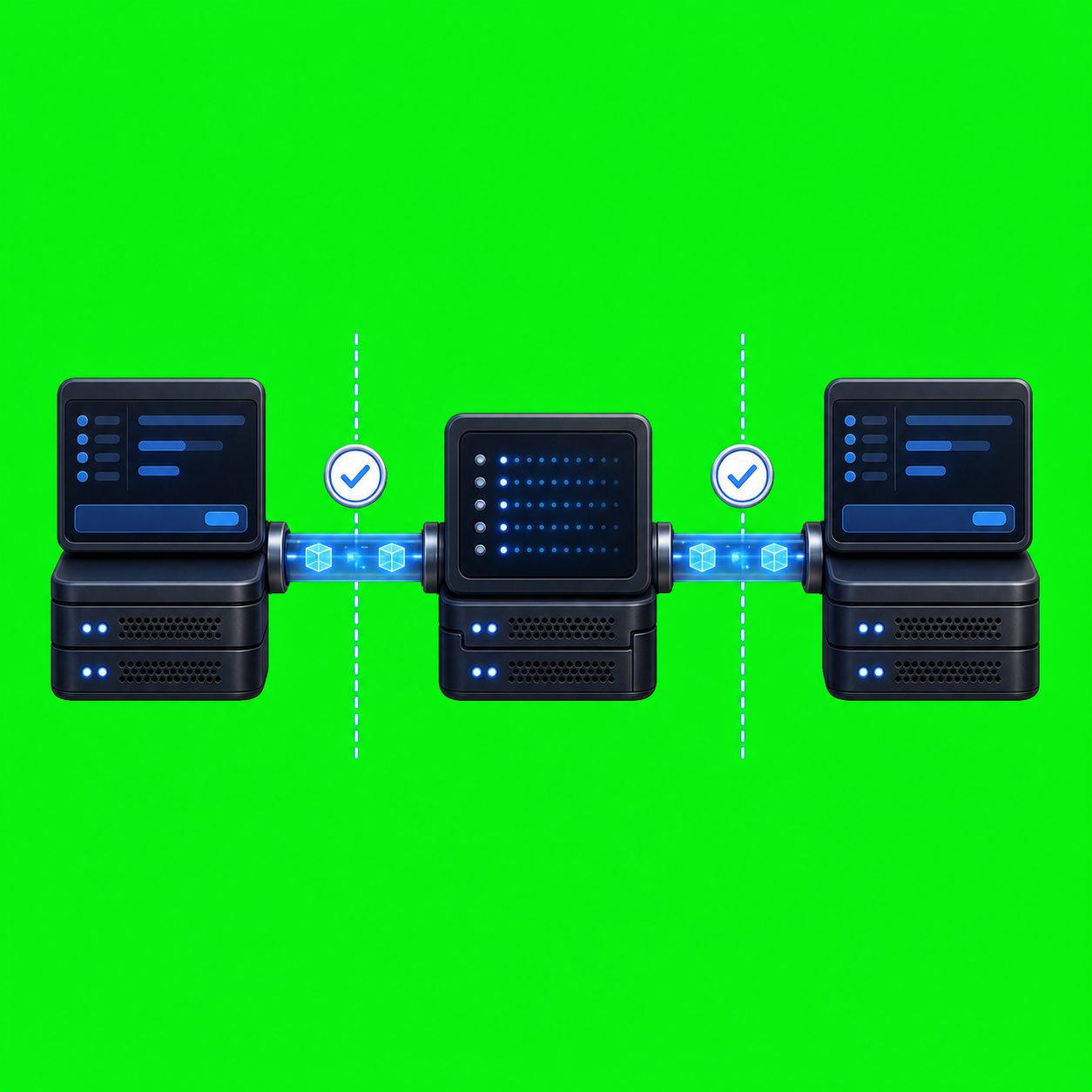
Why AxiOwl Avoids Open Inbound Manager Ports
Open inbound manager ports are tempting in agent systems because they make routing look simple. Put a manager on a network port, let every node call it, and treat the manager as the center of the system. AxiOwl takes a different path. Its current design keeps coordination local, uses MCP over stdio for provider-facing tools, and reaches remote nodes through explicit SSH command execution instead of exposing an always-listening remote manager to the network.
That choice is not just a security slogan. It follows from how AxiOwl is built. AxiOwl is designed to send one text message from one named agent to one named agent through one selected provider edge, then record evidence about what happened. The repo documentation describes the CLI as a thin command surface, the registry as a simple mapping from agent name to provider session and node, and provider delivery as an explicit edge in the pipeline. Opening a broad inbound manager port would blur those boundaries.
The Local Coordinator Is The Control Point
AxiOwl's user documentation describes the product as a local Windows coordinator for supported provider sessions. It discovers provider sessions and chats, records them in a local registry, sends messages to selected sessions, exposes MCP tools for provider replies, and records receipts and delivery evidence.
The command surface is intentionally small:
axiowl send --to "Target chat name" --body "Message text"
For safer multiline input, the documented shape is stdin:
@'
<full message>
'@ | axiowl send --to "Target chat name" --stdin
That model keeps the operator-facing action concrete. A send request is accepted, resolved, delivered through a selected provider edge, and recorded. The receipt language is also deliberately narrow: accepted_by_axiowl means AxiOwl accepted the request and handed it to delivery. It does not prove the target provider displayed the message or replied.
An open manager port tends to encourage the opposite behavior: many callers, many hidden paths, and vague success states. AxiOwl's design makes the caller use a named command or an MCP tool and then treats the provider result as evidence, not as an implied success story.
MCP Runs Over Stdio, Not A Public Listener
The AxiOwl MCP server is implemented as a process that reads JSON-RPC messages from stdin and writes responses to stdout. The CLI exposes it as:
axiowl mcp-server --host codex --provider codex
The implementation parses MCP Content-Length frames, advertises tools such as axiowl_send_message, axiowl_create_agent, axiowl_list_agents, axiowl_status, and axiowl_node_add, and uses the host MCP session identity to resolve the sender. There is no need for a network listener for this provider integration. The provider launches or talks to the local MCP server through the MCP stdio contract.
That is a practical security boundary. The tool surface is available to the host process that intentionally configured it. It is not a port waiting for any reachable machine to try a request.
Remote Work Uses SSH And Stdio Relay
AxiOwl does support remote nodes, but the current remote path is not "open a remote manager port and call it." The Windows-side remote provider code looks up a node from the node registry, builds an SSH destination from ssh_user and host, optionally includes the configured SSH key, and runs:
axiowl relay-session --stdio
on the remote machine through SSH.
The relay session itself is a stdin/stdout protocol. It emits a hello frame, reads JSON lines from stdin, handles deliver frames, dispatches the message through the remote node's local pipeline or direct provider target, then writes a deliver_result JSON frame back to stdout. Remote discovery follows the same philosophy: it uses SSH to run a remote command and reads JSON-line output, instead of requiring an inbound AxiOwl manager service.
This gives operators a simpler network story. If a machine can already be administered through SSH, AxiOwl can use that authenticated channel. The remote node does not have to expose a new manager TCP port, document a new firewall exception, or keep a custom inbound control plane open.
The Local Service Endpoint Stays Local
The current code has a local service endpoint constant of 127.0.0.1:37661, and the status output reports that local endpoint along with the runtime role. In the current implementation, status also says the local service is not implemented yet and that the CLI is running the direct local pipeline skeleton.
Those details matter because they show the intended direction without pretending the current build has a public manager daemon. Even where a service endpoint exists in the code, it is loopback-scoped. Loopback is a local process boundary, not an internet-facing management API.
For production operations, that distinction is important. A loopback-only coordinator can be protected by the host's normal process, filesystem, and user-account boundaries. A publicly bound manager port needs authentication design, request validation, replay handling, firewall policy, scanning exposure, logging, upgrade procedures, and incident response for a new network service. AxiOwl avoids taking on that surface unless the product actually needs it.
The Registry Carries Node Facts Explicitly
Remote routing in AxiOwl depends on registry records. The architecture plan describes the registry as a table that maps:
agent name -> provider -> provider session id -> node
The CLI includes commands for adding and verifying nodes:
axiowl node add --id <node-id> --host <host> --ssh-user <ssh-user> --key <ssh-key-path>
axiowl node verify --id <node-id>
Node verification runs an SSH identity check on the target, including hostname, whoami, pwd, and hostname -I. That is a much more inspectable model than "some remote manager accepted a connection." The operator can see which node is registered, which SSH user is used, which key is configured, and whether the node can actually be reached.
The same pattern appears in the remote Linux installer. It installs /usr/local/bin/axiowl, installs the Codex plugin payload, writes an MCP config that launches /usr/local/bin/axiowl mcp-server --host codex --provider codex, and verifies that the MCP server exposes axiowl_send_message. The installed remote integration is still command and stdio oriented.
Why This Is Better Operationally
Avoiding open inbound manager ports gives AxiOwl four practical advantages.
First, it reduces exposed attack surface. A custom manager listener would become a target on every enrolled node. With the current model, remote access uses SSH, which operators already know how to restrict, audit, rotate, and disable.
Second, it keeps failure modes honest. The code returns explicit errors for missing node registry entries, missing host or ssh_user, SSH failures, missing relay results, and provider delivery failures. AxiOwl's documentation is also clear that a handoff receipt is not the same as a provider reply. That honesty is easier to preserve when there are fewer hidden network hops.
Third, it preserves the provider-edge architecture. AxiOwl wants all delivery to pass through a fixed sequence: receive request, resolve sender, resolve target, build the final visible body, choose the provider edge, send, record evidence, and return a receipt. A generic inbound manager API would invite shortcuts around that sequence.
Fourth, it fits mixed local and remote work. A local Windows coordinator can talk to local provider sessions. A Linux remote endpoint can receive a relay frame through SSH and run its local provider path. MCP tools can be made available to provider hosts through stdio. Each layer does one job, and no layer has to pretend it is a public control plane.
The Tradeoff
This design does mean AxiOwl depends on working SSH configuration for remote nodes. Node records need correct hostnames, users, and keys. Operators need to verify the remote identity. Remote payloads need to be installed so axiowl relay-session --stdio and the MCP server are available on the remote machine.
That is a deliberate tradeoff. AxiOwl chooses explicit enrollment and authenticated command execution over a permanently open manager socket. For an agent coordination tool, that is usually the right default: fewer exposed ports, clearer routing evidence, and a smaller trust boundary.
Closing
AxiOwl avoids open inbound manager ports because its real architecture does not need them. Local providers use a local coordinator and stdio MCP. Remote nodes are reached through SSH and a stdio relay session. The registry records which node and provider session should receive a message, and the pipeline records what happened.
The result is a system that is easier to reason about under pressure. When a message is sent, the operator can trace the command, the registry entry, the SSH relay if one was used, the provider edge, and the receipt. That is more valuable than a convenient manager port that quietly expands the network surface of every node.